Rehabilitation is the process by which the patient regains lost abilities or learns to compensate for disabilities to become more independent.
It is formally defined as “an active process by which those who are disabled by injury/disease achieve a full recovery, or if full recovery is not possible, realise their optimal physical, mental and social potential and are integrated into their most appropriate environment".
The patient will work with a team of professionals; the team consists of doctors, nurses, physiotherapists, occupational therapists, speech and language therapists, dieticians, therapy assistants, psychologists, social workers and a pharmacist.
Aims of Stroke Rehabilitation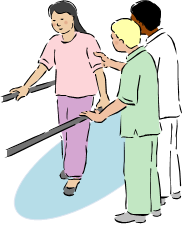
The aim of the stroke rehabilitation programme is to enable the patient to:
- Relearn lost skills
- To find practical support for life after the stroke
- To adapt to the limitations caused by the stroke
- Learn new skills
The section below outlines the most common methods and activities involved in the stroke rehabilitation process, this list is by no means complete:
Physiotherapy
- Help the patient to learn how to re-use their affected limbs
- Increase their endurance and strength
- Stop/reduce muscle waste.
- Help the patient overcome some of the limitations of stroke such as drop foot through technology like FES (Functional Electrical Stimulation). What is Functional Electrical Stimulation?
Occupational Therapy
- Helping the patient to perform simple daily activities that may have become difficult such as dressing, bathing, and using kitchen utensils. The simplest things can be such a struggle in the early stages of rehabilitation.
Nursing
- Prevent falls and make sure that the patient is safe.
- Encourage and support the patient. It is important for all health care providers to give the stroke patient and their family member’s encouragement and support. This can be a very difficult time for them. The rehabilitation process can also be physically and mentally exhausting.
- Encourage as much independence as possible.
- Feeding Hemiplegia patients by placing the food on the good side of the mouth.
- Provide good skin care to reduce the chances of pressure ulcers.
- Assist the patient with their assistive and supportive devices.
- Follow the ordered bowel and bladder retraining program.
- Help the patient with their activities of daily living. Help them bathe, get dressed and eat.
- Assist the patient with their mobility.
- Do range of motion exercises with the patient.
- Encourage and support the patient after the stroke.
Speech and Language Therapy
- Help the patient to communicate via speech and/or writing. The writing will also help re-train affected arms/hands.
- If the stroke has caused a swallowing disorder, a word board can be used so the patient can communicate their needs.
Dietetics
- Help plan out and maintain healthy, well balanced meals to build up strength and their immune system.
- Easy to use utensils can be used to help with Hemiplegia such as easy-hold cups.
Social Services
- Before the patient is discharged from hospital a home assessments should carried out by the local authority.
- The local authority can give the carers advice ranging from general advice to help applying for financial support.
- Help to provide aids, equipment and home adaptations recommended by a community nurse, physiotherapist or occupational therapist. A place at a day centre which could include transport to and from home, hot meals, information and advice activities, and social events.
- Home help or care assistant and home services, such as meals on wheels and a laundry service.
- Respite care can also be arranged.
A Pharmacist would ensure all appropriate medicines are prescribed and gives advice to the patient about their medication.
The stroke rehabilitation period
Rehabilitation begins on a stroke unit or a general ward and continues for a period of time determined by the following:
- The patients progress
- The patients needs
- The patients overall clinical situation.
The patient can only be treated on a stroke unit for a limited period of time depending on clinical needs and local policy.
The average length of stay on a stroke unit in the UK is about 28 days. Rehabilitation may need to continue on other rehabilitation wards, community hospitals and Intermediate care facilities. Rehabilitation can also continue at home if needed.
Some stroke patients may not need rehabilitation if their strokes are less severe and they have recovered well.
Some patients are too ill to benefit from rehabilitation. Their strokes may be too severe; they may be in a coma or have other medical problems that hamper the rehabilitation process. People, who are already very disabled, have dementia or other serious medical conditions often do not progress with rehabilitation.
Recovering from a stroke can take time and there is no guarantee all the physiotherapy and other rehabilitation methods will restore all the functions the patients had before.
* The information on this page has been compiled from various sources. It does not cover all physical conditions, ailments or treatments. The information should NOT be used in place of visit with your healthcare provider, nor should you disregard the advice of your health care provider because of any information you read on this page.